
Last updated September 25, 2026
Seasonal ADU Care for Hemet: Year-Round Homeowner’s Guide
A mini-split heat pump installed in a Hemet ADU loses measurable efficiency if its outdoor coil accumulates the alkaline dust common to the San Jacinto Valley floor. That condition develops in eight to twelve weeks during dry months, and most equipment warranties exclude coverage if the filter log shows missed service intervals. In this guide, you’ll learn how Hemet’s specific climate - triple-digit summers, sub-freezing winter nights, and Santa Ana wind events that deposit fine particulate into every mechanical system - creates a maintenance calendar distinct from coastal Southern California or the mountain communities forty minutes east. For more guides & resources, see our blog. We’ll walk through what to do, when to do it, and how to document it.
Quick Answer
Hemet ADU owners should follow a four-season maintenance schedule detailed in our ADU Design & Permitting Maintenance Checklist for Hemet Homeowners: summer focuses on cooling system coils and cool-roof coatings; fall prepares for Santa Ana winds and freeze risk; winter protects pipes during sub-freezing nights and replaces filters after wildfire smoke; spring inspects flat roofs, concrete slabs, and deck hardware after rain and soil expansion. Year-round documentation of this work supports habitability compliance and insurance claims.
Table of Contents
- Summer ADU Maintenance in Hemet (June-September)
- Fall ADU Maintenance in Hemet (October-November)
- Winter ADU Maintenance in Hemet (December-February)
- Spring ADU Maintenance in Hemet (March-May)
- Year-Round Documentation for Hemet ADU Owners
- Special Considerations for Prefab and Modular ADUs
- Common Mistakes to Avoid
- When to Call a Professional
- Frequently Asked Questions
Summer ADU Maintenance in Hemet (June-September)
Hemet averages 110 days above 90°F and regularly sees sustained stretches above 105°F. That heat does not merely make an ADU uncomfortable; it accelerates material failure in predictable ways that most homeowners miss until the repair is expensive.
Mini-Split and Evaporative Cooler Coil Cleaning
The alkaline dust on the San Jacinto Valley floor is finer than typical desert dust and more corrosive to aluminum fins. We inspect outdoor coils monthly from June through September in Hemet ADUs. For evaporative coolers, the media replacement schedule compresses to every 4-6 weeks during peak dry months, not the 8-10 weeks that works in more humid climates. The media hardens with mineral buildup; once stiff, airflow drops and pump strain increases.
For mini-split heat pumps, the procedure is straightforward but specific:
- Shut off power at the disconnect, not just the thermostat.
- Remove the fan guard and inspect the coil with a flashlight - look for fin compression, not just surface dust.
- Rinse from the inside out with a low-pressure hose; high pressure folds the fins.
- Apply foaming cleaner rated for aluminum, wait five minutes, rinse again.
- Document the date and condition with a photo for your log.
We include this coil inspection in our ADU Design & Permitting in Hemet mechanical specifications, because equipment placement - whether the outdoor unit sits on the valley floor or an elevated pad - changes how quickly dust accumulates.
Cool-Roof Coating Inspection
Cool-roof coatings on flat or low-slope ADU roofs degrade measurably after Hemet’s peak UV season. The thermal expansion coefficient of these coatings means that 105°F surface temperatures create micro-cracking at seams and penetrations. We inspect in late September, not mid-summer when the surface is too hot to walk safely.
Look for chalking (a powdery residue when you rub the surface), alligatoring (interconnected small cracks), and separation at flashing details. If more than 15% of the field shows chalking, re-coating is typically more cost-effective than spot repair, because the substrate adhesion is failing uniformly.
Exterior Caulk at West-Facing Windows
West-facing window and door perimeters in Hemet ADUs see the most extreme thermal cycling. Caulk installed with a standard 25-year rating often fails in 18-24 months under sustained 105°F exposure because the substrate behind it - typically OSB or fiber-cement - expands and contracts at a different rate than the vinyl or aluminum window frame.
We specify high-movement sealants (±50% joint movement capability) on New Detached ADU in Hemet projects, and we recommend annual inspection of existing caulk lines. The failure pattern is predictable: the caulk separates from the window frame, not the wall, because the frame heats faster. Probe with a putty knife; if the caulk lifts cleanly, it’s lost adhesion and water will follow.
Fall ADU Maintenance in Hemet (October-November)
Fall in Hemet is brief and consequential. The Santa Ana wind season overlaps with cooling-system shutdown and heating-system startup, creating a narrow window where ember risk, debris accumulation, and detector testing all demand attention before the first freeze.
Santa Ana Wind Preparation
Hemet’s position at the eastern edge of the Los Angeles Basin means Santa Ana winds arrive with lower humidity and higher velocity than in coastal areas. Fine particulate penetrates gable vents, soffit vents, and any gap larger than 1/16 inch. The specific risk for ADUs is ember entry during wind-driven wildfire events, which have increased in frequency across Riverside County.
Our fall checklist for Hemet ADU owners:
- Inspect vent screens for corrosion or gap opening; replace with 1/8-inch metal mesh, not fiberglass.
- Seal gaps around conduit, plumbing penetrations, and dryer vents with fire-rated caulk.
- Clear dead vegetation within 5 feet of the ADU structure; Hemet’s chaparral fuels dry rapidly in October.
- Test battery-backed vents if installed; power loss during wind events is common.
Older Hemet neighborhoods, particularly those with mature eucalyptus plantings, accumulate bark and leaf debris in gutters at rates that surprise newer residents. Eucalyptus leaves contain oils that accelerate gutter corrosion and create fire-ready fuel if they dry in place. We clean gutters in October, not after the first rain, because wet debris is heavier and harder to remove completely.
Smoke and CO Detector Testing Before Heating Season
Hemet’s sub-freezing nights trigger heating system use that has been dormant for eight months. Test every detector with the manufacturer’s test button, not just a visual check. Replace units older than ten years; the ionization sensors degrade predictably. For ADUs with propane or natural gas heating, CO detector placement matters: mount within 15 feet of sleeping areas and at the height specified by the manufacturer (CO mixes with air differently than smoke).
Winter ADU Maintenance in Hemet (December-February)
Hemet averages 15-20 nights below freezing each winter, with January lows occasionally dropping into the mid-20s, a topic addressed in ADU Permits, Codes & Inspections in CA: What You Need to Know. That is cold enough to split unprotected pipes, particularly in garage conversion ADUs where the original slab was not designed for habitation-grade insulation.
Pipe Freeze Prevention in Crawl Spaces and Garage Conversions
Garage conversion ADUs in Hemet - the most common ADU type we design - often retain the original uninsulated perimeter foundation. Water lines routed through crawl spaces or along exterior walls freeze when overnight temperatures drop below 28°F for more than four hours. The damage is not immediate; pipes split during thaw, when pressure builds behind ice blockages.
Prevention measures, in order of reliability:
- Insulate all exposed supply lines with minimum R-4 pipe insulation; R-6 in north-facing walls.
- Seal crawl space vents with rigid foam inserts from November through February; remove them in March to prevent moisture buildup.
- Maintain minimum thermostat setting of 55°F, even in unoccupied ADUs; the cost of heating is lower than emergency plumbing repair.
- For ADUs with hose bibs, install frost-free sill cocks with the valve seat inside the conditioned space, not at the exterior wall.
We specify these details in our Garage Conversion ADU in Hemet permit sets because the original garage slab and wall assembly rarely meet habitation-grade thermal performance without modification.
HVAC Filter Replacement After Wildfire Smoke Events
Winter wildfire smoke in Riverside County has become more frequent. Standard 1-inch fiberglass filters do not capture fine particulate (PM2.5). After any smoke event, replace filters with MERV 13 pleated filters if your system can handle the static pressure increase. Check the blower motor amp draw against the nameplate rating; overloaded motors fail prematurely. Document the filter change date and the smoke event in your maintenance log - this supports warranty claims if compressor or heat exchanger damage is later disputed.
Spring ADU Maintenance in Hemet (March-May)
Hemet’s spring rainfall is modest - typically 2-3 inches total - but it arrives in concentrated events that test roof drainage and soil stability. The freeze-thaw cycles of winter also leave their mark on concrete and hardware.
Flat and Low-Slope Roof Inspection
Flat roofs on ADUs, common in both site-built and modular construction, depend on positive drainage. After spring rain, inspect for ponding - water standing longer than 48 hours after the rain stops. Ponding indicates either structural deflection or blocked drains. The specific Hemet concern is UV degradation of membrane seams during summer, which spring moisture penetrates. Check seams at penetrations and edges for lifting or adhesive failure. A seam that lifts 1/4 inch will channel water in the next storm.
Concrete Slab Crack Monitoring
Expansive clay soils in the San Jacinto Valley swell with spring moisture and shrink through summer desiccation. This cycle cracks concrete slabs, including ADU foundation slabs and patio slabs that affect drainage toward the structure. Mark existing cracks with a pencil and date; measure width with a crack monitor gauge ($15 at hardware stores). Movement exceeding 1/8 inch in a single season warrants evaluation by a structural engineer - not because the slab has failed, but because the differential movement may stress wall-to-slab connections or plumbing penetrations.
Deck Hardware Corrosion Check
Winter moisture, even limited moisture, corrodes deck hardware faster in Hemet than in drier desert climates because of the alkaline soil chemistry. Inspect ledger board bolts, joist hangers, and post bases with a flashlight and screwdriver. Flaking rust on galvanized hardware indicates the zinc coating has failed; the steel beneath corrodes rapidly. Stainless steel hardware, specified on higher-end projects, shows pitting rather than flaking - also a replacement signal. Tighten any loose bolts; the expansion-contraction cycle loosens them over time.
Year-Round Documentation for Hemet ADU Owners
Maintenance documentation is not bureaucratic overhead. Under California Civil Code §1941, landlords must maintain habitable conditions, and a documented maintenance log is the primary defense against tenant habitability claims. For owner-occupied properties, the same documentation supports insurance claims when system failures are disputed.
What to Record
Each maintenance event should include:
- Date and weather conditions (relevant for freeze and smoke events).
- Specific location within the ADU or on the property.
- Condition observed, with a photograph.
- Action taken, including product names and specifications (e.g., “MERV 13 filter, 20x25x1, replaced”).
- Next scheduled inspection date.
We provide a maintenance log template to every Ellery ADU Studio Hemet home client at final inspection, pre-populated with the specific equipment brands and installation dates from their project. This is part of the documented photo record we maintain on every visit - clients receive evidence of what was found and what was done, not a summary of how it felt.
Insurance and Warranty Alignment
Equipment warranties increasingly require proof of maintenance. A mini-split compressor warranty may be voided if filter replacement logs show gaps exceeding 90 days. Roofing material warranties often exclude “lack of maintenance” as a cause of failure. Your log should be contemporaneous - recorded at the time of service, not reconstructed after a claim. Digital logs with geotagged photos and cloud backup are admissible in California small claims court; paper logs should be scanned.
Special Considerations for Prefab and Modular ADUs
Prefab and modular ADUs, including systems from Cover, Dvele, and Mighty Buildings, arrive with manufacturer-specific maintenance protocols that differ from site-built construction. The single-contract advantage of our design-build model is that these protocols are integrated into the project handover documentation, not left for the owner to locate in a PDF buried on a manufacturer’s website.
Manufacturer-Specific Items
Cover units use proprietary wall assemblies with integrated mechanical chase spaces; access panel locations must remain unobstructed for service. Dvele units include smart home monitoring systems that flag HVAC filter status remotely - but the physical filter still requires replacement, and the alert does not replace visual coil inspection. Mighty Buildings uses a thermoset composite material that does not crack like stucco, but expansion joints at module connections require annual inspection for sealant continuity.
The common thread: prefab maintenance is not less maintenance, just different maintenance. We specify and coordinate these systems under the same single contract as site-built work, so neither the designer nor the builder can point at the other when a maintenance access issue arises.
Common Mistakes to Avoid
- Using coastal California maintenance schedules in Hemet. The marine layer moderates temperatures and humidity in Los Angeles and San Diego; Hemet’s inland desert climate accelerates UV degradation and dust accumulation by 40-60%. A schedule that works in Orange County fails here.
- Ignoring the garage conversion’s original construction. Garage slabs in Hemet were poured without vapor barriers or perimeter insulation as standard practice before 2010. Assuming the slab performs like a habitation-grade foundation leads to moisture and freeze damage that proper ADU-specific prep would prevent.
- Skipping fall gutter cleaning until after the first rain. Eucalyptus debris in older Hemet neighborhoods compacts when wet and corrodes galvanized gutters from the inside out. Clean dry debris in October; remove wet debris immediately if you missed the window.
- Documenting maintenance from memory. Contemporaneous records carry weight in warranty disputes and habitability claims. A log reconstructed after a pipe freeze has no evidentiary value.
- Assuming prefab means maintenance-free. Modular wall assemblies and integrated systems have specific access and sealant requirements. The manufacturer’s warranty requires adherence to their schedule, not a generic one.
- Neglecting to adjust thermostat in unoccupied ADUs. The cost of maintaining 55°F through a Hemet winter is $40-$80 in a well-insulated ADU. A pipe freeze repair starts at $800 and can exceed $3,000 if flooding damages finishes.
- Using standard caulk at west-facing window perimeters. The thermal cycling at these locations exceeds the movement capability of generic silicone or latex caulk. High-movement sealants cost 30% more and last three times as long in Hemet conditions.
When to Call a Professional
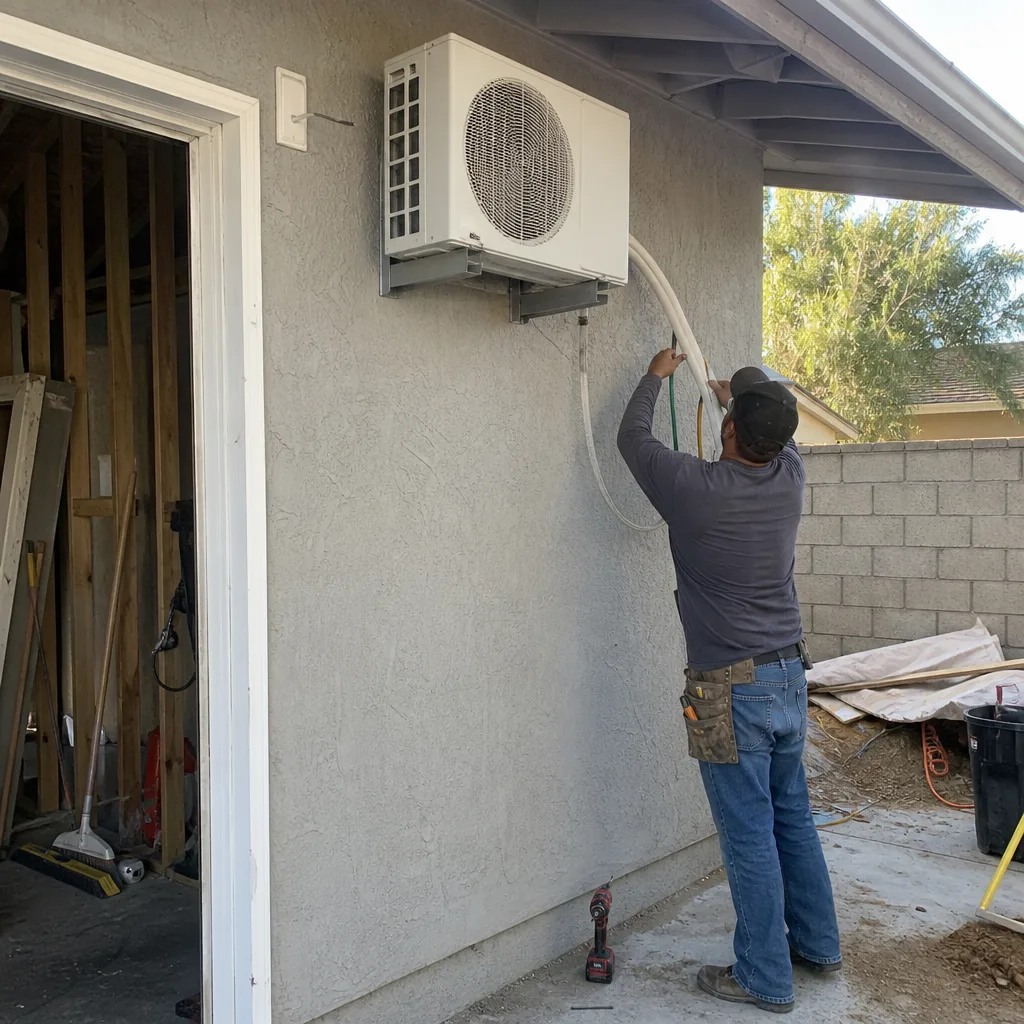
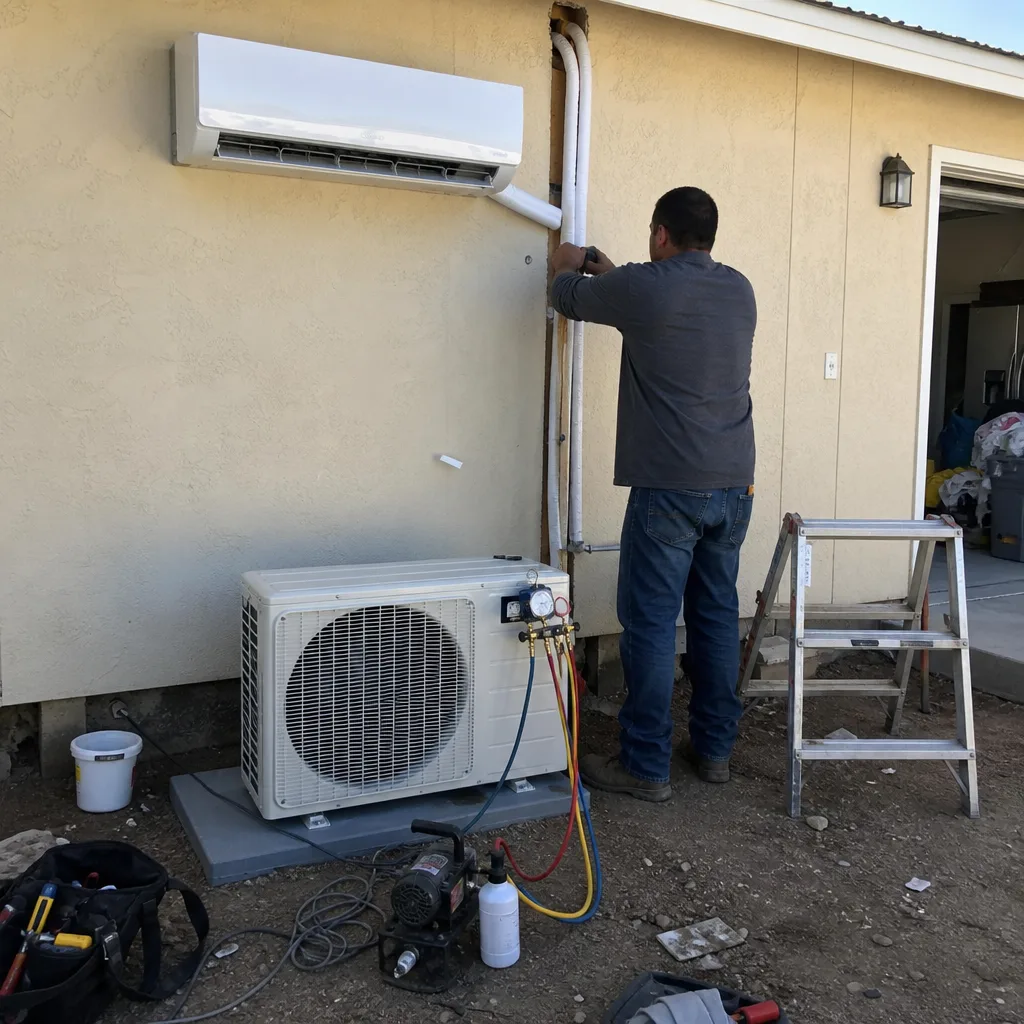
Some maintenance tasks carry safety risks that outweigh cost savings. Mini-split refrigerant lines operate at pressures that can cause frostbite or eye injury; coil cleaning is appropriate for homeowners, but refrigerant work requires EPA certification. Roof inspection on slopes steeper than 6:12 belongs to crews with fall protection. Electrical panel work, including breaker testing and GFCI verification, should be performed by a licensed electrician - the California Contractors State License Board maintains a lookup tool for verification.
Structural concerns - slab movement exceeding 1/8 inch in a season, wall cracks that step through mortar joints, or roof sagging - warrant prompt evaluation. These are not emergency conditions unless accompanied by active water intrusion, but they do not improve with delay.
Ellery ADU Studio Hemet offers free estimates for ADU owners evaluating maintenance needs, system upgrades, or concerns about original construction adequacy. Call (951) 430-0167 to schedule.
Frequently Asked Questions
Homeowners who perform routine tasks themselves spend $200-$400 annually on filters, sealants, and minor materials. Professional seasonal service packages from licensed contractors in Hemet typically run $600-$1,200 per year, covering coil cleaning, gutter service, detector testing, and documented roof inspection. Call (951) 430-0167 for an exact quote - estimates are free, and every project is quoted with a written price before any work begins, per Haven Standard Clause 1.
Replace 1-inch pleated filters every 60-90 days during normal operation, and every 30 days during active wildfire smoke events or sustained Santa Ana wind periods. Mini-split systems with washable filters should be cleaned monthly from June through September due to valley dust accumulation. The manufacturer’s stated interval assumes moderate dust; Hemet’s alkaline particulate loads filters faster.
Under Clause 5 (No Surprises) of The Haven Standard, the scope is locked at signing; no door-side upsells, no scope creep. If our inspection reveals conditions outside the agreed scope, we document them with photographs and provide a separate written amendment for your approval before additional work proceeds. The original written price remains unchanged for the original scope.
Routine maintenance - filter replacement, cleaning, caulking, gutter service - does not require permits. Work that alters structural, electrical, or plumbing systems does. In Hemet, the Building Division at 445 E. Florida Avenue processes permits for ADU modifications; typical review times are 10-15 business days for minor alterations. We pull all required permits as part of our ADU Design & Permitting in Hemet service and pass all inspections before final payment.
Check three items: whether supply lines run through insulated walls or crawl spaces, whether the original slab has perimeter insulation, and whether the thermostat maintains minimum 55°F. If any answer is no, the freeze risk is elevated. We evaluate these conditions during our Free Second Opinion on any written estimate already in hand - no obligation, documented findings.
A maintenance log with dated entries, specific locations, actions taken, product specifications, and photographs satisfies Civil Code §1941 defense requirements. The log should cover heating, plumbing, weatherproofing, and structural safety systems. We provide a template pre-populated with your ADU’s specific equipment at project completion; ongoing entries are the owner’s responsibility.
The Bottom Line
Hemet’s climate demands a maintenance calendar tuned to triple-digit summers, Santa Ana winds, sub-freezing winter nights, and spring soil expansion. The specific tasks - coil cleaning intervals, high-movement sealants at west windows, eucalyptus debris management, crawl space vent sealing, and flat roof seam inspection - differ materially from generic California guidance. Documentation of this work protects warranty coverage, supports insurance claims, and satisfies habitability requirements. The cost of systematic maintenance is modest compared to the cost of deferred failure.
Call (951) 430-0167 to schedule your free estimate. Every project is quoted with a written price before any work begins, backed by our 365-Day Done Right Promise, and documented with a photo record on every visit.
Written by Nadia Ellery, Owner at Ellery ADU Studio Hemet, serving Hemet since 2015.